
Published in Market Intel by Bruce Morgan
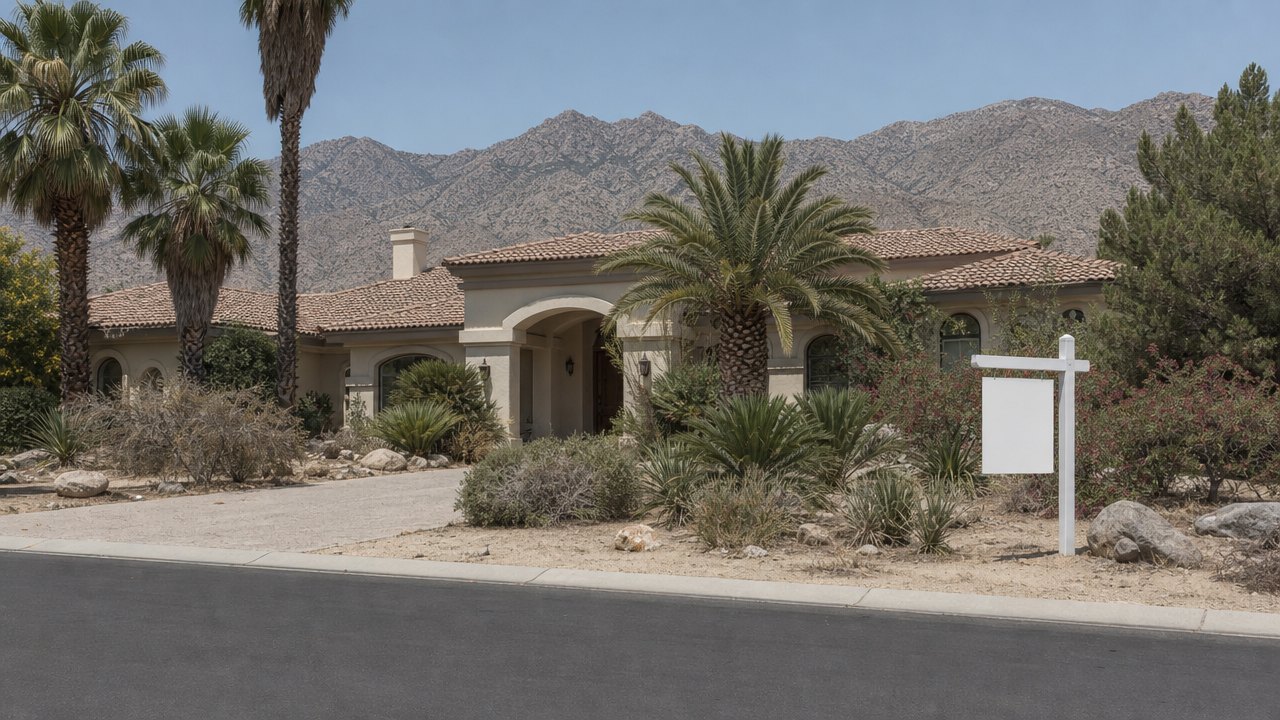
A seller I worked with was convinced his home was worth $3.2 million. It was a large, custom-built home from the early 2000s on a great lot with a view that stopped you in your tracks. But there had been no upgrades. The kitchen and baths were dated. The floor plan felt a little choppy for today's buyers. The comps put the valuation at $2.8 million.
He listed at his number anyway.
The home had never been on the market before, so it generated real buzz those first three weeks. One couple viewed it four times and verbally committed to a $3 million offer if the seller would carry back a short-term note. Three million. That was $200,000 above comps. My client agreed to the financing terms but refused the price.
After that, the traffic dried up completely. The only showings we got were from agents "shopping" the listing to make their own properties look like a better deal. After eight months, the listing expired. So preventable.
Every seller who overprices has a reason that makes sense to them. They anchor to what their neighbor sold for in 2022. They add the cost of their remodel. They price based on what they need from the sale. None of that matters to the market.
Here is the math most sellers never see.
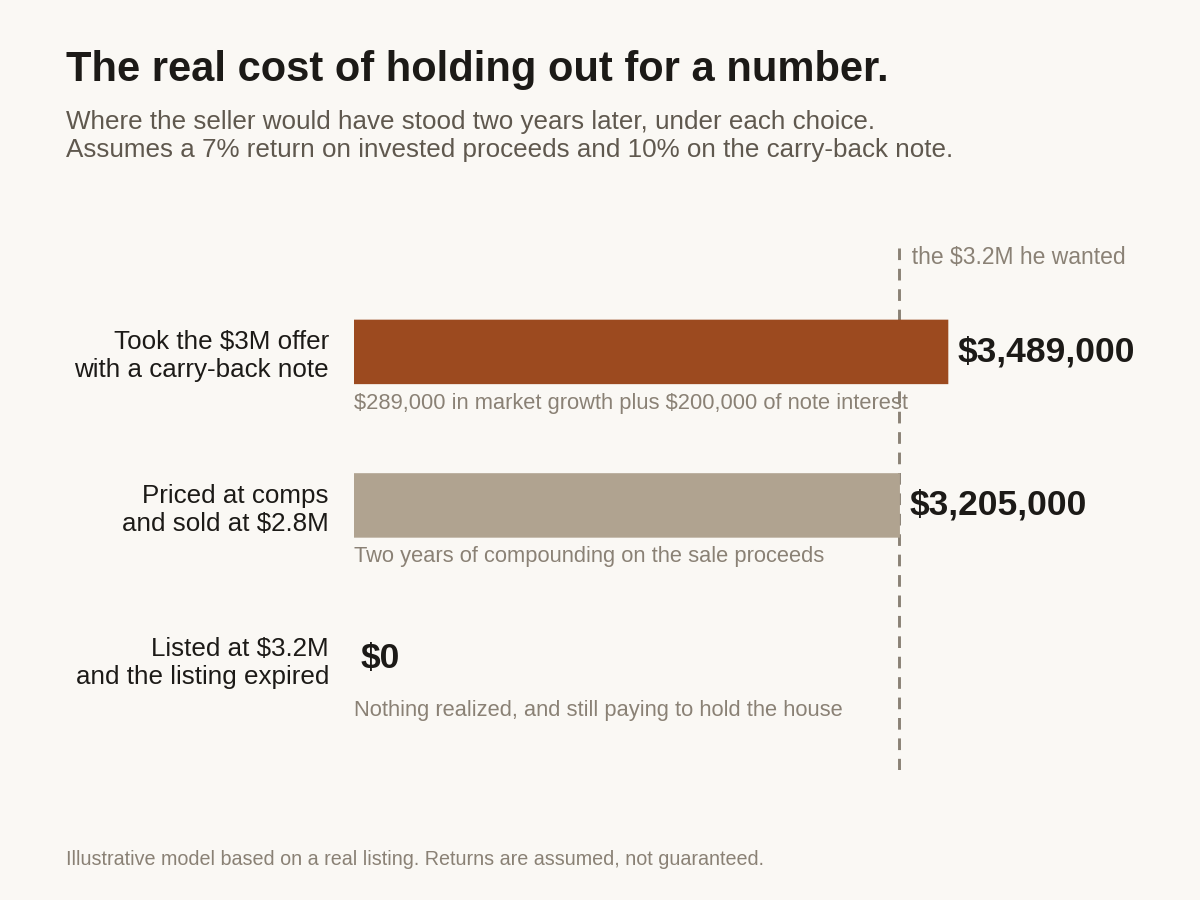
If my client had accepted that $3 million offer, taken $2 million in cash and carried back $1 million for two years at a hard money rate of 10%, and invested the $2 million proceeds in the stock market at a 7% return, he would have had $3,489,000 at the end of two years. That is $289,000 in market growth plus $200,000 in interest from the carry-back note.
Even if he had simply priced at my comps of $2.8 million and invested all proceeds, his position after two years would have been approximately $3,205,000. He wanted $3.2 million. The market would have gotten him there. He just wanted to get there the hard way.
I call this opportunity cost. It is the price of stubbornness and holding out for an imaginary number, when a real valuation and a real sale would have immediately started generating gains. And that does not even factor in the carrying costs: mortgage, utilities, property taxes, insurance, maintenance, pool, landscaping, and the upgrades the home still needed.
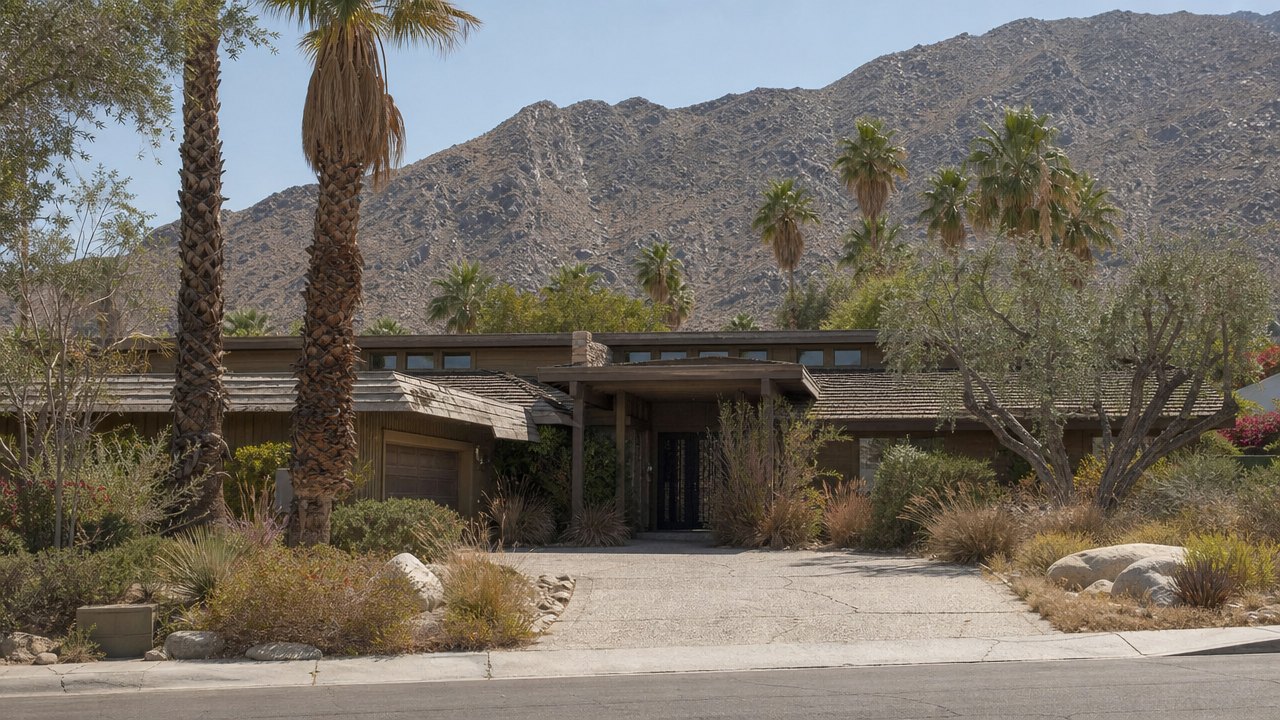
I had another seller who inherited a three-bedroom home that was a real fixer. Beautiful lot, exceptional neighborhood, incredible pool and outdoor kitchen. But the home was dirty. Carpets needed cleaning, dry rot in the exterior wood, bare electrical wires in the panels, paint colors that were severe, and pest issues.
The comps put it at $950,000 to $1.05 million as an as-is offering. The seller priced it 20% above that.
We had strong early interest. Four different investors and builders ran their renovation numbers and offered $1 million cash, as-is. The seller said no to every one. An architect brought his builder in with a similar result. Then a written offer came in around $900,000 from qualified buyers with a pre-approval letter from a lender. The seller refused, finally agreed to counter, and then suddenly insisted the buyers pay their own agent's commission plus a list of unreasonable contingencies.
The buyers vanished. We never heard from them again.
The real estate market has a built-in clock, and most sellers do not know it exists.
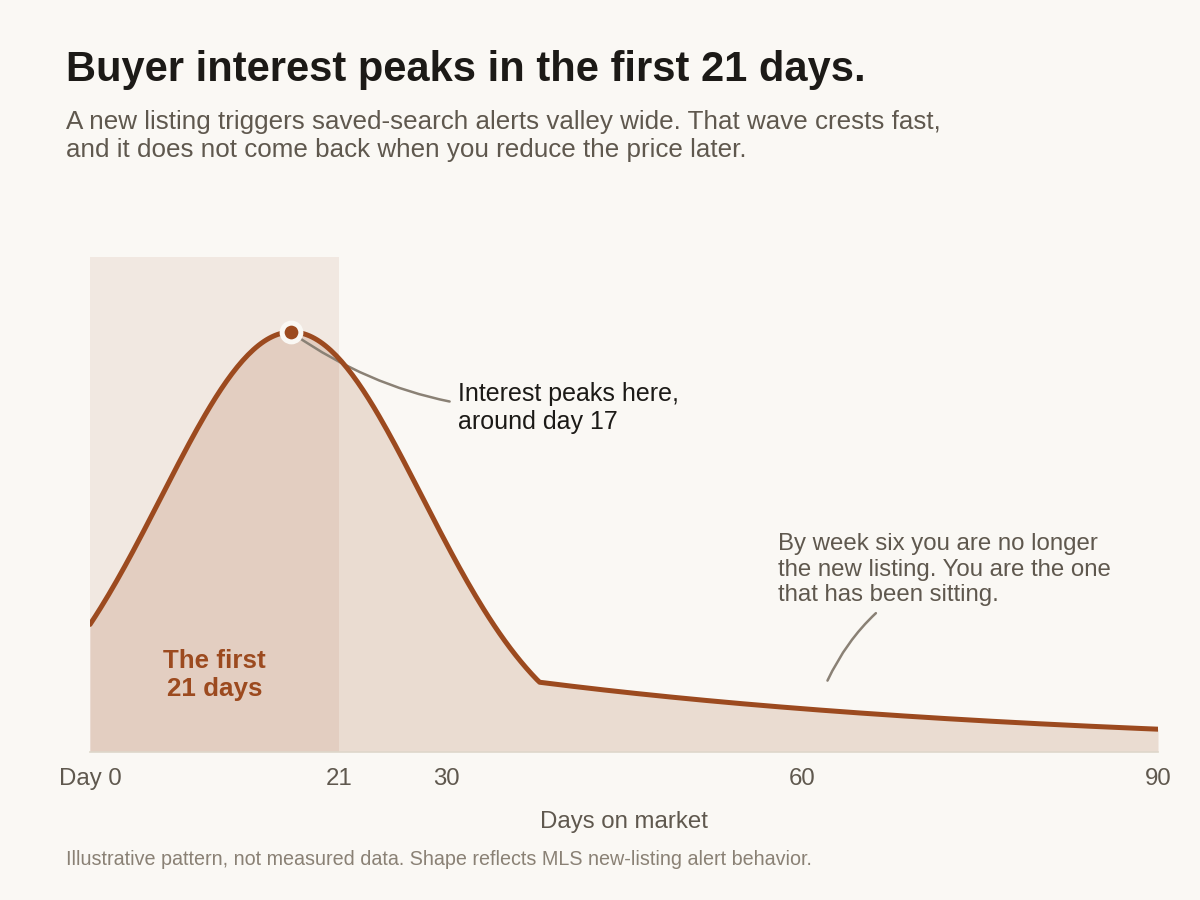
When a home hits the MLS, it triggers search alerts for every buyer's agent in the valley. Buyers who have saved searches for PGA West, Bighorn, Toscana, Mission Hills, or any other community get an email the same day. Their agents call them. Showings get scheduled. That first wave of interest peaks in the first 14 to 21 days.
Price it right, and you capture that wave. You generate showings, you create competition, you negotiate from strength.
Price it too high, and those buyers skip past your listing without a second look. They are not going to call and negotiate your price down during the first week. They are simply going to look at the next property that is priced within range. Your home sits. The search alerts stop. The momentum is gone.
By the time you reduce the price six weeks later, you are no longer the new listing that everyone is excited about. You are the listing that has been sitting. Buyer's agents notice. Their clients notice. And the question shifts from "what do we love about this home?" to "what is wrong with it?"
Nothing is wrong with it. You just overpriced it.
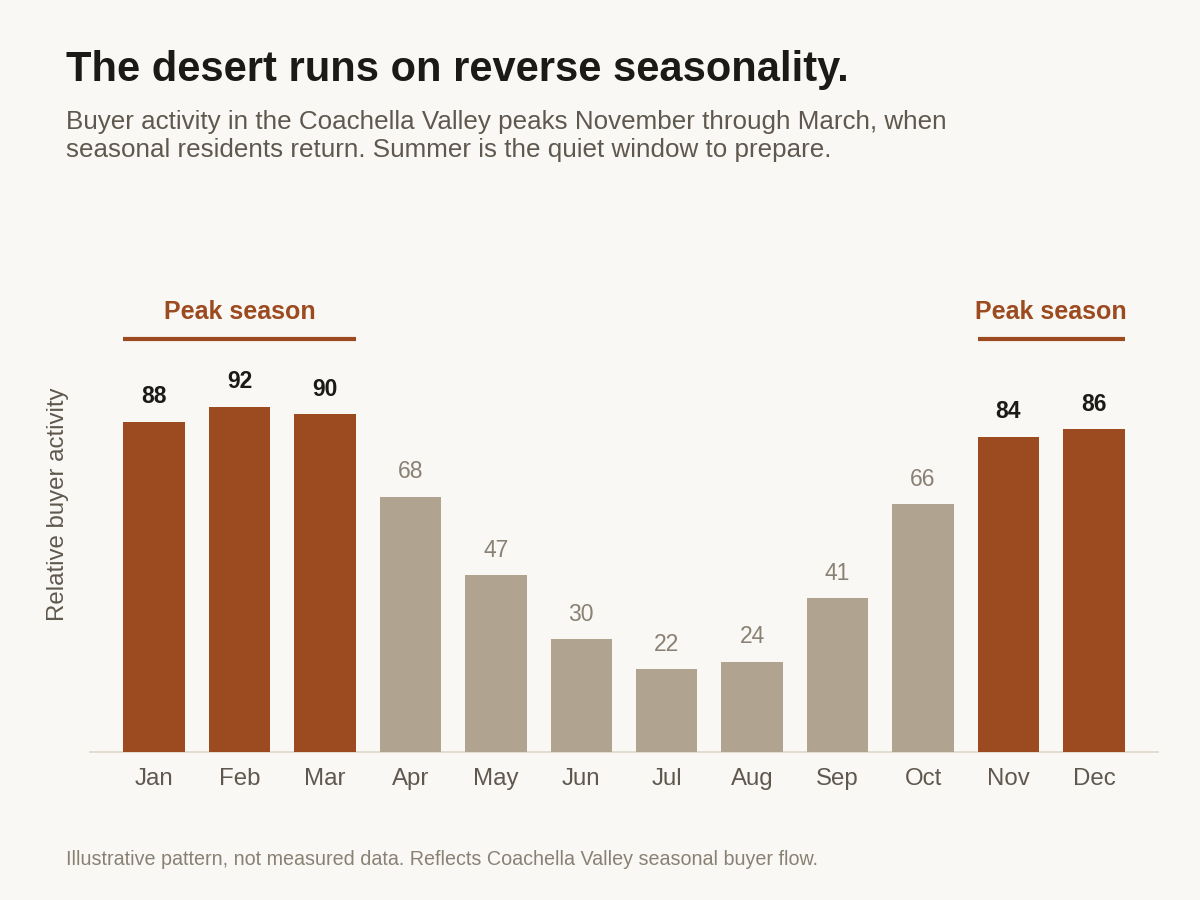
The Coachella Valley has a seasonal rhythm that amplifies the cost of getting this wrong.
Buyer activity peaks between November and March. If you overprice in October and spend November through January sitting, you are burning through the strongest months of the selling season with a stale listing. By February, new listings flood in from sellers who prepared during the quiet summer months. Your listing, now four or five months old with a price reduction, is competing against fresh inventory.
The other desert-specific factor is the size of the buyer pool at higher price points. At $500,000, there are hundreds of potential buyers in the valley. At $2 million, there may be 15 to 20 in any given month. At $4 million, the pool shrinks to single digits. When you overprice at that level, you are not just losing a few interested buyers. You may be losing the only two or three people actively looking in your price range that season.
Pricing a home correctly is not about leaving money on the table. It is the opposite.
A well-priced home generates more showings in the first two weeks than an overpriced home generates in three months. More showings create more interest. More interest creates competition. Competition is what drives final sale prices above asking.
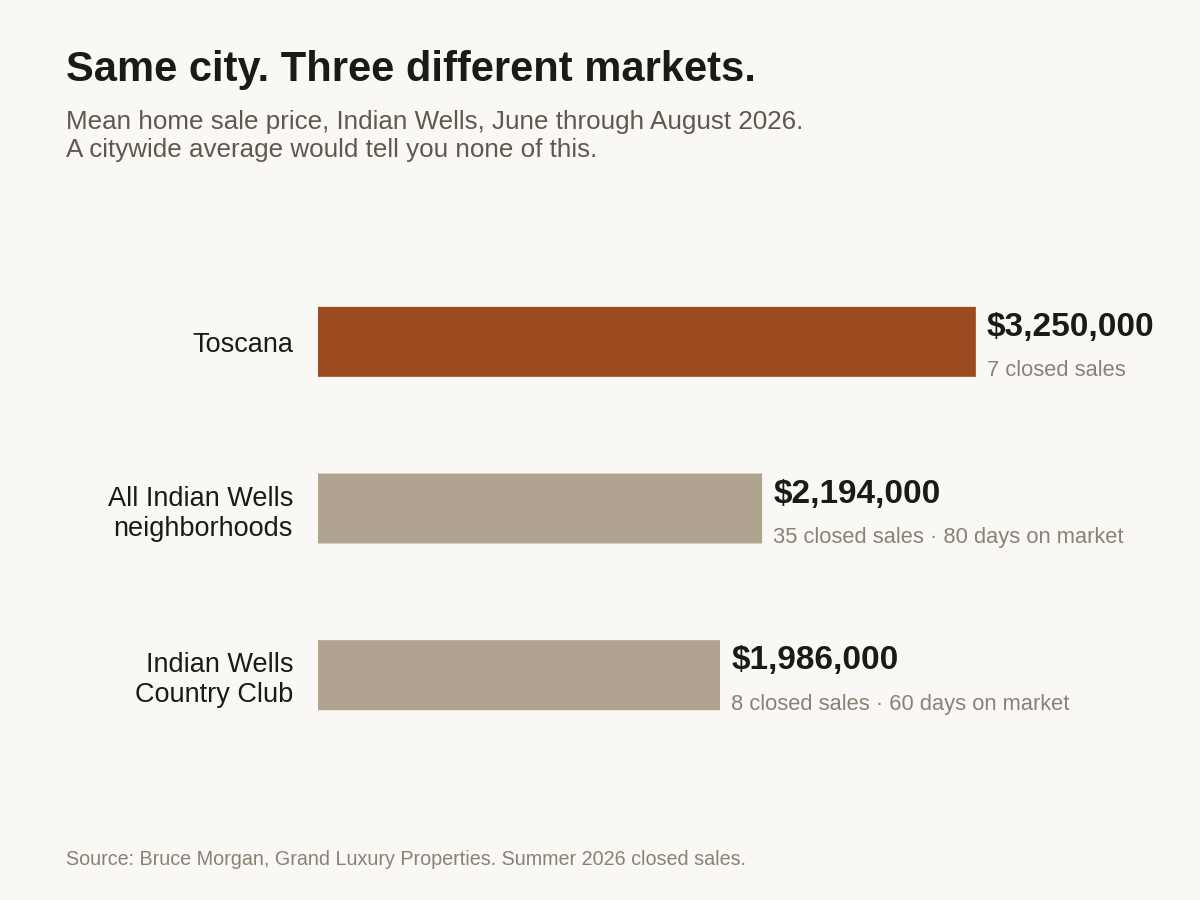
The right price comes from recent closed sales in your specific community, current active inventory, and an honest assessment of your home's condition relative to what has sold. In Indian Wells alone, the mean sale price across all neighborhoods this summer was $2,194,000, but inside IWCC it was $1,986,000, and in Toscana it was $3,250,000. Those are three very different numbers within the same city. Citywide averages are useless. The analysis has to go deeper: the neighborhood, the HOA, the builder, the views, the lot, the privacy.
I came to real estate from a career in medicine where every decision started with data. Diagnosis before treatment. Evidence before action. Pricing a home works the same way. You start with what the market is telling you, not what you hope it will say.
If you are thinking about selling in La Quinta, Palm Desert, Indian Wells, or Rancho Mirage this season, the conversation I want to have with you starts with your home's real position in the current market. No guesswork. No flattery. Just the numbers and a strategy built around them.
Bruce Morgan | REALTOR® DRE #02277792
Grand Luxury Properties
406-370-1224 | desertluxeproperties.com

Fall is when the desert market actually happens. Fresh data on La Quinta, Palm Desert, Indian Wells, and Rancho Mirage, plus what buyers and sellers need to know before the season peaks.